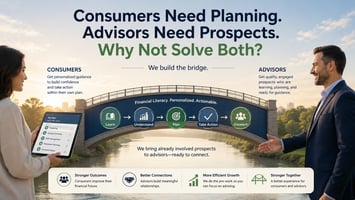
One of the questions I get asked most often is, "If your platform works directly with consumers,...
For the past few decades, financial planning software (FPS) has evolved quickly. While the tools have become faster, slicker, and more automated, they’ve also become more transactionally driven by speed over quality, efficiency over depth, and presentation over participation.
This is not a critique of the software itself. Much of it is powerful and well-designed. The issue lies in the culture that surrounds it, a culture that overvalues velocity and under appreciates engagement.
Even among independent advisors, this culture has shaped how we think about the client experience. And that culture, whether we realize it or not, was inherited from the dominant force in the development of financial planning software: large institutions.
Speed, Institutions, and the Hidden Influence on Planning Culture
The largest buyers and therefore influencers of financial planning software are not small firms or solo practitioners. They are massive financial institutions. Banks, broker-dealers, wirehouses, and insurance firms. These institutions are dedicated to financial advice, staffed by capable and well-trained advisors, supported by integrated technology stacks and compliance departments.
No matter how skilled their advisor teams may be, large institutions operate within a business model designed for scale. That model prioritizes consistency, brevity, and above all, efficiency. The faster an advisor can complete a plan or drive a conversation to a clear outcome, the more time they can redirect toward marketing themselves which, in many cases, is the core expectation of their role. A standardized process also makes it easier for leadership to track, manage, and report across hundreds or even thousands of branches.
This has led to a persistent mindset that still dominates the planning industry: How fast can we do this?
Many independent advisors, even those who have long since left the world of large institutions, continue to operate in that shadow. Why? Because many of them got their start in those institutions. The habits, assumptions, and expectations formed in that environment linger. It’s not uncommon to hear advisors, even fiduciaries, say things like:
- “Clients just want the bottom line.”
- “It needs to be obvious at first glance.”
- “We can’t overwhelm them.”
- “We don’t want to spend too much time on that.”
These are not bad intentions. They’re often driven by a desire to be respectful of the client’s time and attention. But the underlying assumption is that the client can’t or won’t engage more deeply, so we shouldn’t bother trying.
What if we flipped that assumption?
What if the real question isn’t “How fast can we get through this?” but rather, “How can we get the client to stay awhile and engage?”
The Missed Opportunity: Engagement Through Play
Speed may be efficient, but engagement is sticky.
If you’ve ever watched a client lean forward, ask more questions, start clicking through different inputs on their own, or even come back to their plan unprompted, you’ve seen the magic of engagement. And the most powerful form of engagement is play.
We don’t talk about play enough in financial planning. That may be because “play” feels frivolous in a profession built on responsibility. But make no mistake, play is the best kind of engagement. It’s exploration. It's a curiosity. It’s the client saying, “What if?” before you even prompt them.
When clients play with their plan, they don’t just get involved. They internalize it. They understand the levers. They ask better questions. They get invested in the outcome.
And questions are golden.
Every question is an opening for education. Every “what if?” is a moment to show how thoughtful planning works. Every new scenario is a chance to deepen the relationship and clarify values. When clients engage with their plan, you’re no longer simply delivering advice. You’re building financial literacy. You’re teaching. You’re growing trust.
We Need More Play in Planning: Both Advisor-Led and Organic
There are two types of play that matter in a financial planning experience. We want both. Ideally, one leads to the other.
Advisor-Led Play
This is where most advisors are already comfortable. It happens in meetings or client portals when you guide the client through a set of predefined scenarios. Maybe you toggle retirement ages, test different savings rates, or show the impact of a pension buyout.
Advisor-led play can be collaborative or directive. It can happen live, in meetings, or asynchronously through tasks or shared dashboards. You are leading the dance, pointing to paths, asking questions, encouraging curiosity.
This kind of play is powerful because it lets you demonstrate your expertise and introduce new thinking. You’re giving clients permission to explore while still providing structure and guidance.
But the real magic happens when clients go further on their own.
Organic Play
Organic play is the ultimate win. It’s when the client engages with their plan unprompted. They’re not completing an assigned task. They’re not filling out a form. They’re just... exploring.
Maybe they log in late at night and test different career changes. Maybe they adjust savings inputs or model the impact of a home purchase. Maybe they start a scenario called “Move to Portugal” or “Start My Own Nonprofit.”
This type of play doesn’t just reveal interest. It reveals ownership.
When clients begin to play with their plan on their own, you’ve created something rare: a space where they feel safe enough, curious enough, and empowered enough to think big. That’s where long-term relationships are built. That’s where you move from service provider to trusted guide.
Scenario Planning Is the Best Medium for Play
Not all parts of the planning process lend themselves to play. But scenario planning? It’s built for it.
Scenario planning invites clients to imagine different futures, test assumptions, and simulate outcomes. It’s inherently interactive. It welcomes experimentation. And with the right platform, it’s easy to do without fear of breaking something.
There are countless ways to use scenarios, but they tend to fall into a few distinct types. Each has its own purpose, but all can be used to encourage play and engagement.
1. The Current Plan
This is the baseline. The “if we change nothing” version of the plan. It’s important because it gives context for all future comparisons. But it’s also the start of play because it invites the question, “What if we did change something?”
2. Recommendations
These are the advisor’s proposed changes such as increasing savings, adjusting asset allocation, delaying Social Security, or refinancing debt. While they’re essential for demonstrating the advisor’s value, they shouldn’t be delivered as static recommendations. Instead, invite the client to engage with them. Let them test ideas by adjusting the details and immediately seeing the impact. This kind of interactive exploration is what we call Iteration. It’s not only the most effective way for clients to play with their plan—it’s also how many advisors actively build plans today.
3. Life Events
These scenarios are built around significant life changes such as divorce, inheritance, job loss, or a major illness. Life event scenarios are especially valuable for engaging clients around risk. They often serve as the ideal context for highlighting the importance of risk management strategies, including the use of insurance products to protect the plan.
4. Stress Testing
These simulate adverse conditions such as recessions, inflation spikes, and much more. They’re not fun, but they’re necessary. They show resilience. And when done collaboratively, they turn anxiety into action.
5. Coaching Scenarios
These scenarios involve the advisor and client actively collaborating to clarify specific aspects of the plan. It might include refining goals, replacing estimates with more accurate data, or working through key assumptions together. Coaching scenarios often begin during advisor-led meetings but can continue independently, giving clients the opportunity to revisit and explore them further through their portal between meetings.
6. Strategic Scenarios
These scenarios tend to be more complex, often involving tax strategies, conversions, or asset transfers. They require thoughtful guidance from the advisor, but they also encourage clients to think about long-term trade-offs and optimization. A common example of a Strategic Scenario—especially for younger clients—is modeling a long-term plan to buy, renovate, and rent out properties. Is it a dream or a strategy? In many cases, it’s both—and exploring it through scenario planning helps bring clarity to that distinction.
7. Educational Scenarios
These are used purely for learning. They help explain concepts like sequence of return risk, tax,or the time value of money. They’re perfect for first-time planners or clients who want to understand why a decision matters.
8. Dream Planning
This might be the most powerful scenario category of all. Dream planning is where imagination takes the lead. These scenarios start with questions like:
- What would my plan look like if I started my own business?
- Can I afford to go back to school and change careers?
- What if we took a year off and traveled the world?
- Could I live and work internationally?
These are deeply personal questions. They’re not just financial, they’re about identity, values, and purpose. And when you give clients space to explore these dreams in a safe, flexible way, you create emotional resonance that no spreadsheet or chart ever could.
Dream planning is where organic play often begins. Once clients see they can model their “what ifs” safely and visually, they begin to own the planning process. And that ownership is the beginning of real engagement.
The Takeaway: Don’t Just Plan for Clients, Plan With Them
Too much of financial planning has become transactional. Even with beautiful tools and intelligent automation, many client experiences feel rushed, formulaic, and surface-level.
We’re still asking the same question the institutions ask: “How fast can this go?” This may be the wrong question.
The better question is: “How can we create an experience where the client wants to stay, explore, and engage?”
When you prioritize engagement over speed, when you design for curiosity rather than compliance, and when you invite clients to play with their future you transform the entire planning relationship.
Play is not a distraction. It’s not a gimmick. It’s a feature. It’s how we make planning human again.
*****************************************************************************************************************************************

Click below to get a better understanding of how scenario planning works.
Try PlanTechHub Premium for 14 days free - no credit card required.
-1.png?height=200&name=Blog%20Artwork%20(2)-1.png)
.png?height=200&name=Blog%20Artwork%20(8).png)